How to Use AI 3D Rendering to Create Stunning Visuals for Your Projects
In today's competitive landscape, the ability to create stunning visuals is paramount for any project, whether in architecture, gaming, or product design. AI 3D rendering has emerged as a revolutionary tool, empowering creators to simulate lifelike visuals with unprecedented speed and accuracy. According to a recent report by the International Data Corporation (IDC), the 3D rendering market is projected to reach $12 billion by 2025, driven largely by advancements in AI technology. This growing reliance on AI-driven solutions signifies not just a trend, but a pivotal shift in how creative industries approach visual representation.
Industry experts are recognizing the transformative impact of AI 3D rendering. For instance, Dr. Emily Johnson, a prominent figure in the field of computer graphics, notes, “AI 3D rendering is enabling artists and designers to push the boundaries of creativity and efficiency, allowing them to focus more on innovation rather than tedious rendering processes.” With AI's ability to streamline workflows and enhance detail, the barrier to entry for high-quality visualization has been significantly lowered, democratizing access to stunning artistic expression. As we delve into practical applications and techniques, it becomes clear that harnessing the power of AI 3D rendering can elevate any project to new heights.

Understanding the Basics of AI 3D Rendering Technology
AI 3D rendering technology is revolutionizing the way visuals are created across various fields, from architecture to gaming. At its core, AI 3D rendering involves the use of artificial intelligence algorithms to enhance the speed and quality of the rendering process. Traditional rendering often requires extensive manual input and can be time-consuming, but AI-powered tools can automate many of these tasks, allowing for faster results without compromising on detail. This technology leverages machine learning models to analyze and predict visual outcomes, making it possible to generate high-quality images with minimal human intervention.
Understanding the basics of AI 3D rendering requires familiarity with its foundational concepts such as ray tracing, texture mapping, and scene optimization. Ray tracing simulates the way light interacts with objects in a scene, providing realistic shading and reflections. Texture mapping involves applying images or patterns to 3D models to create lifelike surfaces. Meanwhile, scene optimization focuses on enhancing the efficiency of rendering processes by managing the complexity of the 3D environment. By integrating these principles with AI, creators can produce captivating and immersive visuals that engage audiences more effectively, ultimately transforming their projects into visual masterpieces.
Key Benefits of AI in the 3D Rendering Process
AI technology is revolutionizing the 3D rendering process, offering several key benefits that significantly enhance the quality and efficiency of visual project development. One of the primary advantages is the acceleration of rendering times. Traditional rendering methods can be time-consuming, often taking hours or even days to produce high-quality images. However, with AI-assisted rendering techniques, artists can achieve stunning results in a fraction of the time. This rapid turnaround allows for more iterations and the exploration of creative ideas without the long wait, ultimately leading to a more efficient workflow.
Another benefit lies in the ability of AI to enhance realism in visuals by analyzing and learning from vast datasets of high-quality images. AI algorithms can simulate complex lighting, textures, and materials, producing results that are often indistinguishable from real life. This capability not only elevates the aesthetic quality of the rendered images but also allows creators to focus on other creative aspects of their projects, knowing that the rendering itself is being expertly handled. By leveraging AI in the 3D rendering process, artists and designers can push the boundaries of their creativity, resulting in breathtaking visuals that captivate audiences.
Step-by-Step Guide to Creating 3D Models for Rendering
Creating 3D models for rendering is a meticulous process that, when done correctly, can yield stunning visuals to enhance any project. According to the 2023 "State of 3D Design" report by a leading industry organization, over 75% of designers have adopted 3D rendering techniques to bring their ideas to life, highlighting the increasing reliance on this technology across various sectors, including architecture, gaming, and product design. To initiate this process, one must begin with a clear concept and reference images that will guide the modeling phase. Utilizing software tools such as Blender or Maya allows designers to create intricate models by sculpting basic shapes, adding textures, and refining details that contribute to a realistic appearance.
Once the model is established, the next step involves preparing it for rendering. This means setting up lighting, materials, and camera angles. An interesting finding from the same industry report indicates that optimal lighting can enhance visual appeal by up to 40%. Properly configured lighting not only showcases the model's features but also sets the mood for the final product. To ensure top-notch output, it's also essential to understand the rendering settings specific to the chosen software. Utilizing techniques like ray tracing can produce lifelike shadows and reflections, while tuning the resolution and sampling rates can significantly improve the quality of the rendered image, promoting a polished, professional look that captivates the audience.
3D Rendering Techniques Popularity (2023)
Techniques for Enhancing Visual Quality in AI Rendered Images
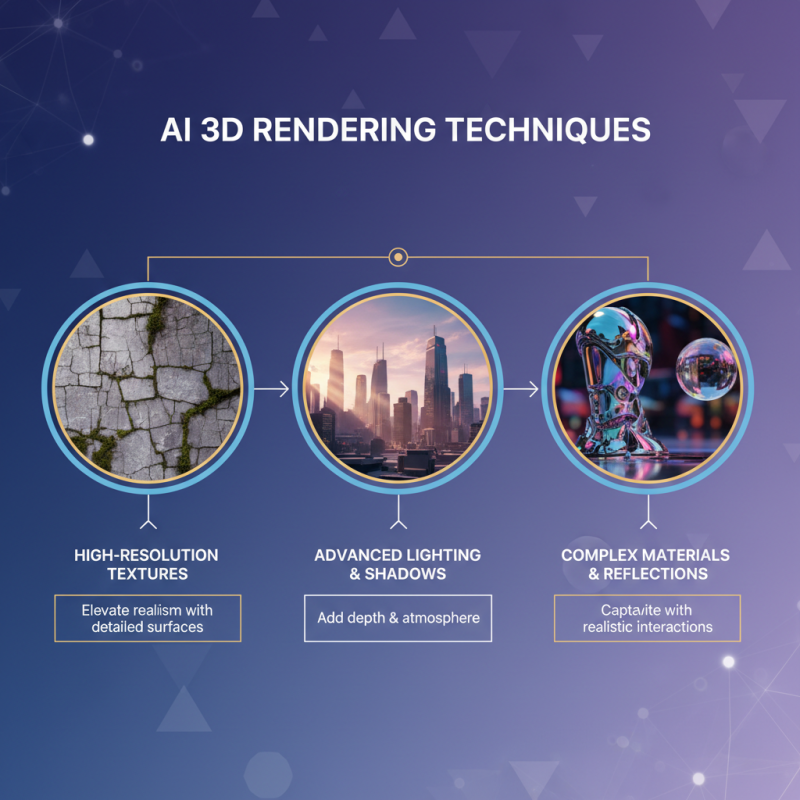
AI 3D rendering has revolutionized the way we create visually striking images, making it accessible for various projects. To enhance visual quality in AI-rendered images, it's essential to focus on several key techniques. First, consider the use of high-resolution textures. Incorporating detailed textures can significantly elevate the realism of your images, allowing surfaces to exhibit intricate details that captivate viewers.
Tips: Always opt for textures that match the scale of your objects. For instance, if you're rendering a large building, use textures that convey the appropriate size and complexity, ensuring consistency in your overall visual narrative.
Another powerful technique is adjusting lighting settings to enhance depth and dimension. Effective lighting can transform a flat image into a dynamic experience by creating shadows and highlights that give a sense of realism. Experiment with different light sources, angles, and intensities to find the perfect balance that complements the mood of your project.
Tips: Use three-point lighting for a more dramatic effect. This technique involves key, fill, and back lights, which together can enhance depth and focus on specific elements within your composition.
Common Tools and Software for AI 3D Rendering Projects
Artificial Intelligence (AI) has revolutionized the landscape of 3D rendering, offering powerful tools that enhance creative possibilities for designers and artists alike.
A significant shift in the industry is evident, as a report from Research and Markets indicates that the global 3D rendering services market is expected to grow from USD 1.0 billion in 2021 to USD 2.8 billion by 2026, with a CAGR of 22.9%. This growth underscores the increasing reliance on advanced rendering solutions that streamline the design process while improving visual quality.
Among the various tools available for AI-driven 3D rendering, several standouts have emerged due to their intuitive interfaces and robust capabilities.
Software that employs machine learning algorithms can predict lighting, textures, and materials in real time, dramatically reducing rendering times from hours to mere minutes. According to a survey by Statista, 45% of industry professionals cite speed and efficiency as critical benefits of AI tools. These advancements enable creators to explore more complex ideas without being constrained by traditional limitations, allowing for greater innovation in visual projects.
As the demand for high-quality graphics surges, the importance of leveraging sophisticated AI solutions becomes increasingly clear.